

From Cabinet Repair to a Four-Year Relationship
At a glance
- Client: Mandarin homeowners
- Timeframe: June 2022 to present
- Scope over time: Cabinet correction and refinishing, hallway wall resurfacing, drywall seam repair, ceiling repair, popcorn ceiling cleanup, skylight patching, interior painting, exterior fascia repainting, bedrooms, doors, and a pool deck in the pipeline
- Result: A client who now calls Tina first for everything, and who says he will not hesitate to call again
The short version
Most painting jobs end when the last coat dries. This one kept going. What began in June 2022 as a call to fix problems on brand-new cabinets grew into years of work across nearly every part of the house: walls, ceilings, cabinets, doors, and the exterior. Along the way, Tina solved problems that other tradespeople had worked around or ignored, and she was honest when her own work needed a second look. That honesty turned out to be the most valuable thing she delivered.

Where it started: new cabinets, avoidable problems
The homeowners had just had a cabinet company install new cabinets. The installation left them with scratches and dings, handles drilled in the wrong spots, and a hinge placed incorrectly. These are the kinds of mistakes that are annoying precisely because the cabinets are new and the homeowner has just spent real money.
She repaired the damage and refinished the affected cabinets so the corrections disappeared into the surrounding finish. The client noticed right away. In their words, Tina’s fix matched perfectly.
The cabinets were the entry point, but the homeowners were also in the middle of a larger remodel, and Tina’s suggestions on the rest of the project were, as the client put it, “spot on.” While she was working on the cabinets, more of the house came into scope.
Fixing what other trades had left behind
A recurring theme of this project is that Tina was often brought in after someone else’s work fell short. Each time, the fix required understanding why the earlier work failed, not just covering it up.
The hallway: a texture most people would have torn out
The hallway walls had a heavy, dense texture that looked like someone had troweled on joint compound with a spatula. It was thick and uneven, and the common wisdom on a surface like that is that there is no good way around it other than stripping the wall back or tearing it out and starting over.
Tina took a different route. She scraped and sanded the texture down and skimmed over it, repeating the process until the wall came out perfectly smooth. It avoided demolition, saved the homeowners the cost and mess of a rebuild, and delivered a flat, clean surface ready for paint.


The living room: seams that kept coming back
In the living room, the walls and ceiling had repair work where the drywall crew had done seam work, and those seams kept cracking. The drywall had not even been finished or painted yet, and the tape work was already failing.
Tina fixed what was failing, then skimmed and floated out the seams so they were no longer visible, then primed and painted the living room and the kitchen. The seams stayed put, and the walls looked the way new walls should.
The exterior: a peeling problem, and an honest diagnosis
Some time after the interior work, the homeowners had Tina repaint the exterior. The fascia board, which runs around the roofline, was the main concern. It had a lot of peeling and flaking, and the working assumption was that a previous painter had skipped primer or failed to apply it correctly.
Tina saw it the same way at first. When she stripped the peeling paint, she couldn’t see primer underneath, which seemed to confirm the theory. She repaired and repainted the fascia, applying primer and patching where needed.
Then, about three to six months later, the client called her back: the paint was peeling again.
This is the point in many projects where things get defensive. Tina did the opposite. She had put primer on, she knew it, but she also saw that in the peeled areas she couldn’t see the primer either. That told her the original diagnosis was probably wrong. If primer was invisible in her own work, then the lack of visible primer on the previous painter’s work proved nothing. So she looked more carefully.
What she found
The house had no furring strip behind the drip edge. The metal was sitting directly against the fascia board, which meant rainwater was running straight onto the wood every time it rained. The board never had a chance to truly dry out.
That explained everything. A water barrier, whether it’s paint, primer, or silicone, only works if it goes onto a completely dry surface and then stays protected from constant moisture. A board that’s repeatedly soaked is, in her words, almost like leaving it sitting in a container of water. No coating will hold up, however good the product or the application. The peeling would keep happening until the underlying water problem was fixed.
This was something a previous painter had either missed or never mentioned. The client put it plainly in their review: she noticed a problem with the fascia that other painters never mentioned.
The fix, timed to the roof
The homeowners already had a roof replacement on the horizon. The existing roof was reaching the end of it's recommended life. Tina explained the issue and recommended that the furring strip be added when the new roof went on. The homeowners did exactly that.
Once the roof and furring strip were in place, Tina repainted the fascia. Because she had been the first round she painted hadn’t lasted, even though it wasn't due to her work process, she offered a significant discount on the redo. The homeowners were thrilled, and the fascia now has what it never had before: a dry surface and a real chance to hold paint for a long time. It hasn't peeled since.
Ceilings: skylights, popcorn, and “flashing”
The roof work led to more projects inside, and the ceilings turned out to be some of the most technically demanding work on the job.
Closing the skylights
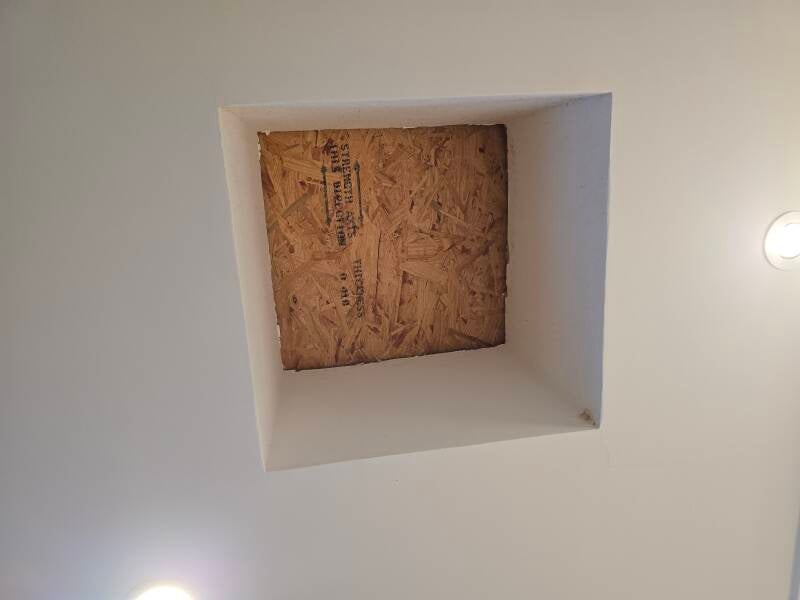
As part of the roof project, the homeowners closed off two skylights. Tina patched them from the inside, including adding insulation into the cubby where each skylight had been. She then sealed the opening with drywall, taped and finished the edges, and painted. The result was a smooth ceiling with no visible sign of the patch.
Cleaning up a popcorn removal
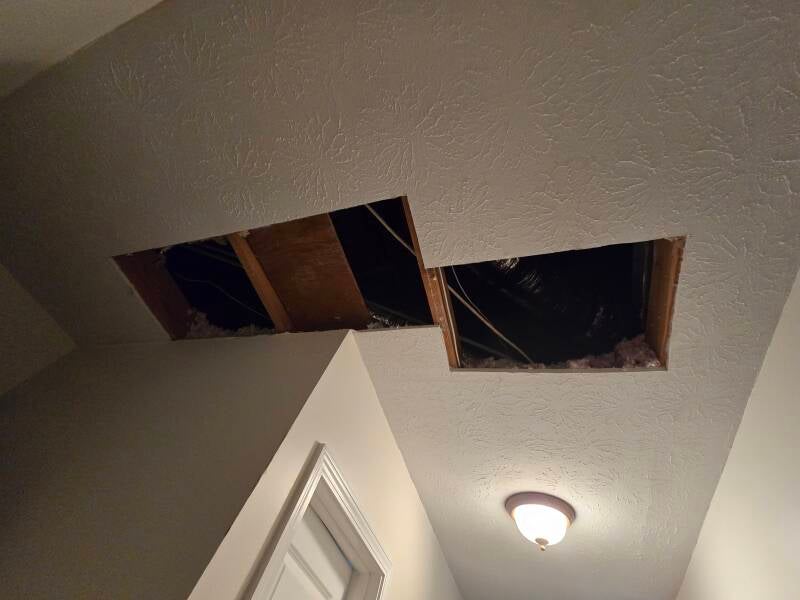
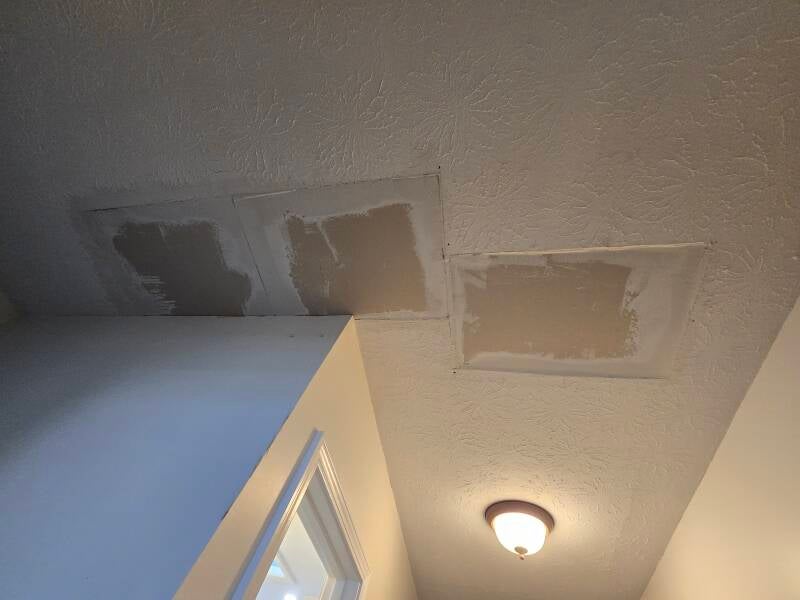
Before ever knowing about Paint It Forward, the homeowners had another contractor remove the popcorn texture from some ceilings. The removal was not done thoroughly, and imperfections were still visible. Tina went over the earlier work, smoothed out the notable flaws, and repainted.
The repainting revealed a second problem. The ceiling appeared to have been sprayed, then touched up with a roller. When you mix those methods, you get what painters call flashing: wet paint meeting dry paint, so that patches catch the light differently from the surrounding ceiling.
The fix was to spray the entire ceiling consistently. That eliminated the flashing and every other issue left over from the earlier patching.

Rolling patches so they disappear
For smaller patches, Tina used a deliberate rolling technique. She worked out where the light was coming into the room and rolled out in sections around the patch, starting in the corners and working toward the shadowed common point of the ceiling. This avoided the common mistake of putting a blob of fresh paint in the middle of a ceiling, where it announces itself. Done this way, the patch is difficult to catch from any angle.
Four years later
The work didn’t stop with the original scope. Since then, Tina has painted additional bedrooms and repainted a couple of doors due to natural wear. She is also on standby for the pool deck when the homeowners are ready for their next project.
What the client said
The homeowners’ own words say it better than a summary can:
"Tina is extremely conscientious and knowledgeable. She first helped us with a remodel of most our home. Her suggestions were spot on and her eye for detail completed the job to perfection. We were upset about damage to our new cabinets, but she offered to paint them and the match up was perfect. She did such a great job we had her return to do the exterior of our home. She noticed a problem with the existing facia that other painters never mentioned. Because of that we were able to correct while doing our roof and now the painting she has done is sure to last a while. Of course this all happened over the span of a few years. I am now getting ready to tackle the pool deck and a few more rooms and I will not hesitate to call her back. I am very happy with the work Tina has done for us."
What this project shows
Paint It Forward LLC solves the cause, not just the symptom. The fascia is the clearest example. Another fresh coat of paint would have looked fine for a season. Finding the missing furring strip fixed the actual problem and protected the homeowners’ investment in both the paint and the new roof.
She owns her mistakes and turns them into value. When her first exterior paint job peeled, Tina didn’t make excuses, even though she had done the painting job correctly. She investigated, found a cause neither she nor the previous painter had caught, and discounted the redo. That is the moment the client’s trust became long-term loyalty.
She finishes what others started. Cracked seams, a heavy hallway texture, an incomplete popcorn removal, a mismatched spray-and-roll ceiling: Tina repeatedly took over work that was already underway and got it right, often by choosing a method others had dismissed.
She builds around the client’s plans. Recommending the furring strip be installed with the new roof, rather than as a separate repair, kept costs down and made the repair permanent.
She earns the next job. A project that started with a cabinet company’s referral has become years of work: bedrooms, doors, and a pool deck still ahead. Repeat clients like this are the best evidence of quality, even if, as Tina notes, a client with dozens of jobs over many years still only leaves one review.